Charlotte cleaning companies lose leads after hours because most of their new-customer demand shows up in the evening — when the office is closed, the phone rolls to voicemail, and the website has no way to answer a simple “how much for a 3-bed bi-weekly?” A 24/7 AI chat widget fixes that by answering the homeowner’s questions instantly and booking the clean on the spot, even at 11 PM on a Sunday. For a growing metro where new residents arrive every week and go looking for a cleaner online, the business that answers first almost always wins — and right now that business is rarely the one that closed at 5.
This is written for cleaning operators across the Charlotte metro — Charlotte, Concord, Gastonia, Huntersville, Matthews, Ballantyne, and the surrounding QC suburbs — who are getting website traffic but not enough booked jobs from it. Every number below is sourced; nothing is invented. Let’s start with where the leaks are.
Key Takeaways
- Speed is the whole game. Firms that contact a web lead within 5 minutes are 100× more likely to reach that lead and 21× more likely to qualify them than firms that wait just 30 minutes (MIT / InsideSales Lead Response Management study).
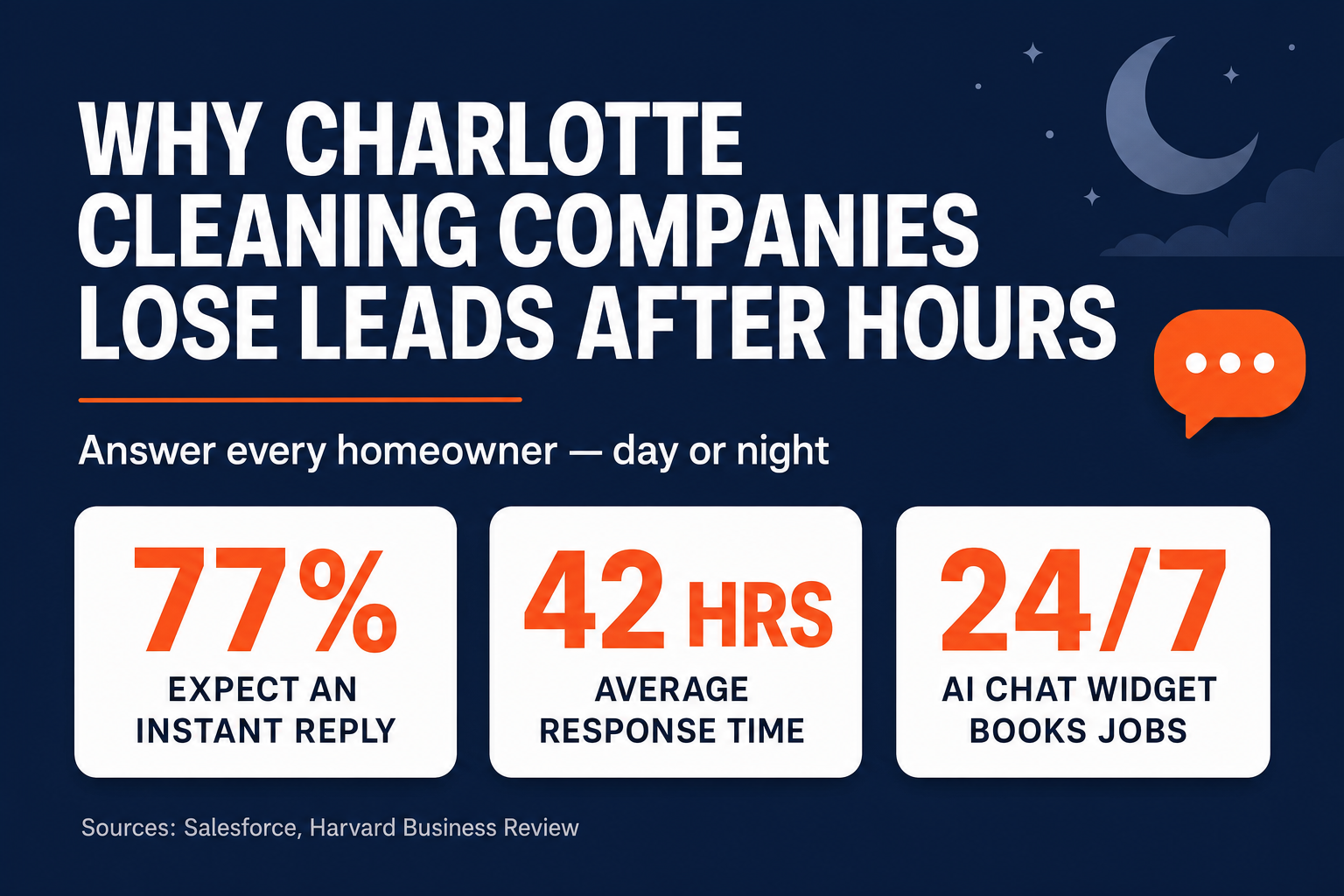
- Most businesses are painfully slow. In an audit of 2,241 U.S. companies, the average first response to a web lead was 42 hours, only 37% replied within an hour, and 23% never responded at all (Harvard Business Review, 2011).
- Homeowners now expect “right now.” 77% of customers expect an immediate interaction when they contact a business (Salesforce, 2023) and 74% expect service to be available 24/7 (Zendesk CX Trends, 2024).
- Charlotte is a fast-growing, homeowner-heavy market. The city passed roughly 904,000 residents with a 51% homeownership rate (Data USA / U.S. Census, 2024), and the metro surged past 2.8 million people in 2025 (U.S. Census via QCity Metro) — a steady stream of new homeowners who need a cleaner.
- An AI chat widget closes the after-hours gap. It answers pricing, availability, and service-area questions in your voice and books the job 24/7 — turning the traffic you already pay for into booked cleans instead of bounced visitors.
Table of contents
- Where Charlotte cleaning leads actually leak
- What a slow (or missed) after-hours lead really costs
- Why homeowners now expect an instant answer
- What an AI chat widget is — and what it isn’t
- How an AI chat widget books a clean at 11 PM
- The Charlotte math: turning after-hours traffic into recurring cleans
- What to look for in an AI chat widget for a cleaning business
- Frequently asked questions
Where Charlotte cleaning leads actually leak
Cleaning is a trust purchase that gets researched at odd hours. A homeowner in Ballantyne isn’t scheduling a quote at 2 PM from their desk — they’re on the couch at 9:30 after the kids are down, three tabs deep into “house cleaning near me,” trying to figure out who services their neighborhood and roughly what a bi-weekly costs. That’s when the decision gets made. And that’s exactly when most cleaning businesses have gone dark.
The result is a quiet, expensive leak. You pay for the website, the Google Business Profile, the local SEO, maybe some ads — all of it working to get a Charlotte homeowner onto your site — and then the moment they have a question, there’s nobody home. A contact form that “someone will get to tomorrow” isn’t an answer; it’s a hurdle. Home-service traffic is overwhelmingly mobile, and the mobile visitor who has to fill out a form and wait is the visitor who taps back to Google and messages the next cleaner instead.
This isn’t a Charlotte-specific failure — it’s the default state of the industry. But it’s a Charlotte-specific opportunity, because the metro is adding homeowners faster than almost anywhere in the country, and the volume of after-hours “who cleans my area?” searches is only going up.
What a slow (or missed) after-hours lead really costs
Here’s the part most operators underestimate: it isn’t just missed leads that hurt — it’s slow ones. The economics of lead response are brutal and well-documented.
The landmark MIT / InsideSales Lead Response Management study analyzed tens of thousands of leads and found that contacting a web lead within 5 minutes rather than 30 minutes made a business 100× more likely to reach that lead and 21× more likely to qualify them. Not 20% better — twenty-one times. The window where a homeowner is actively deciding is measured in minutes, not days.
And yet businesses are slow. Harvard Business Review’s audit of 2,241 U.S. companies found the average first response to a web lead was 42 hours, only 37% responded within an hour, and 23% never responded at all (HBR, 2011). For a cleaning company, “42 hours later” means the homeowner has already booked, scheduled, and forgotten you exist.
Now layer on when the demand actually arrives. Home-service call data from CallRail shows that 41% of inbound calls go unanswered on weekends, versus 18% on weekdays — more than double the miss rate exactly when homeowners have time to shop. Evenings and weekends are your highest-intent windows and your worst coverage windows at the same time.
Percentage of inbound calls to home-service businesses that go unanswered, weekday vs. weekend. Weekend demand is high; weekend coverage is not. Source: CallRail, Home Services Marketing Statistics (vendor data).
Put the two facts together and the cost is obvious: your best leads arrive when you’re least able to respond, and slow responses barely count. A lead you answer in 42 hours is, statistically, a lead you lost.
Why homeowners now expect an instant answer
Consumer expectations have hardened, and cleaning buyers are no exception. People who can get a same-day answer from every app on their phone don’t extend a grace period to the local cleaner.
The data is blunt. 77% of customers expect to interact with someone immediately when they contact a company (Salesforce, State of the Connected Customer, 2023). 74% expect customer service to be available 24/7, and 88% expect faster response times than a year ago (Zendesk CX Trends, 2024). Separately, HubSpot research found 90% of customers rate an “immediate” response as important when they have a question — and most define “immediate” as ten minutes or less (via Help Scout).
What today’s customers expect when they reach out to a business (% of consumers). Sources: Salesforce (2023), Zendesk (2024), HubSpot via Help Scout.
This is the expectation gap you’re operating in. Three out of four Charlotte homeowners assume they can reach a business whenever they want, and the average cleaning company answers a day and a half later, if at all. You don’t close that gap by working longer hours — you close it by putting something on your website that never sleeps.
What an AI chat widget is — and what it isn’t
An AI chat widget is a branded chat window that lives on your website (and can extend to Facebook Messenger and Instagram DMs). It holds a real conversation with a visitor: it answers their questions in your business’s voice, qualifies them, and books the cleaning — or captures their details and hands off to a person when the conversation genuinely needs one.
It’s worth being precise about what it is and isn’t, because “AI” gets slapped on everything:
- It is not a dumb FAQ bot. A good AI chatbot understands natural questions — “do you do move-outs in Concord?”, “what’s included in a deep clean?”, “can you come every other Thursday?” — and answers from the rules you set once, instead of forcing a menu of buttons.
- It is not the same as an AI phone receptionist. An AI caller answers the phone when a call is missed. The chat widget answers the website when a visitor is typing. Most Charlotte operators need both — because some homeowners call and some would rather never talk to a human at all. (If phones are your bigger leak, start with our AI receptionist playbook.)
- It is not a replacement for your team. It handles the repetitive, after-hours, “just need a quick answer” conversations that were bouncing anyway, and routes the complex ones to a human with full context already collected.
How an AI chat widget books a clean at 11 PM
The value only lands if the whole chain works while you’re asleep. Here’s the sequence a good widget runs, end to end, with no human involved until one is actually needed.
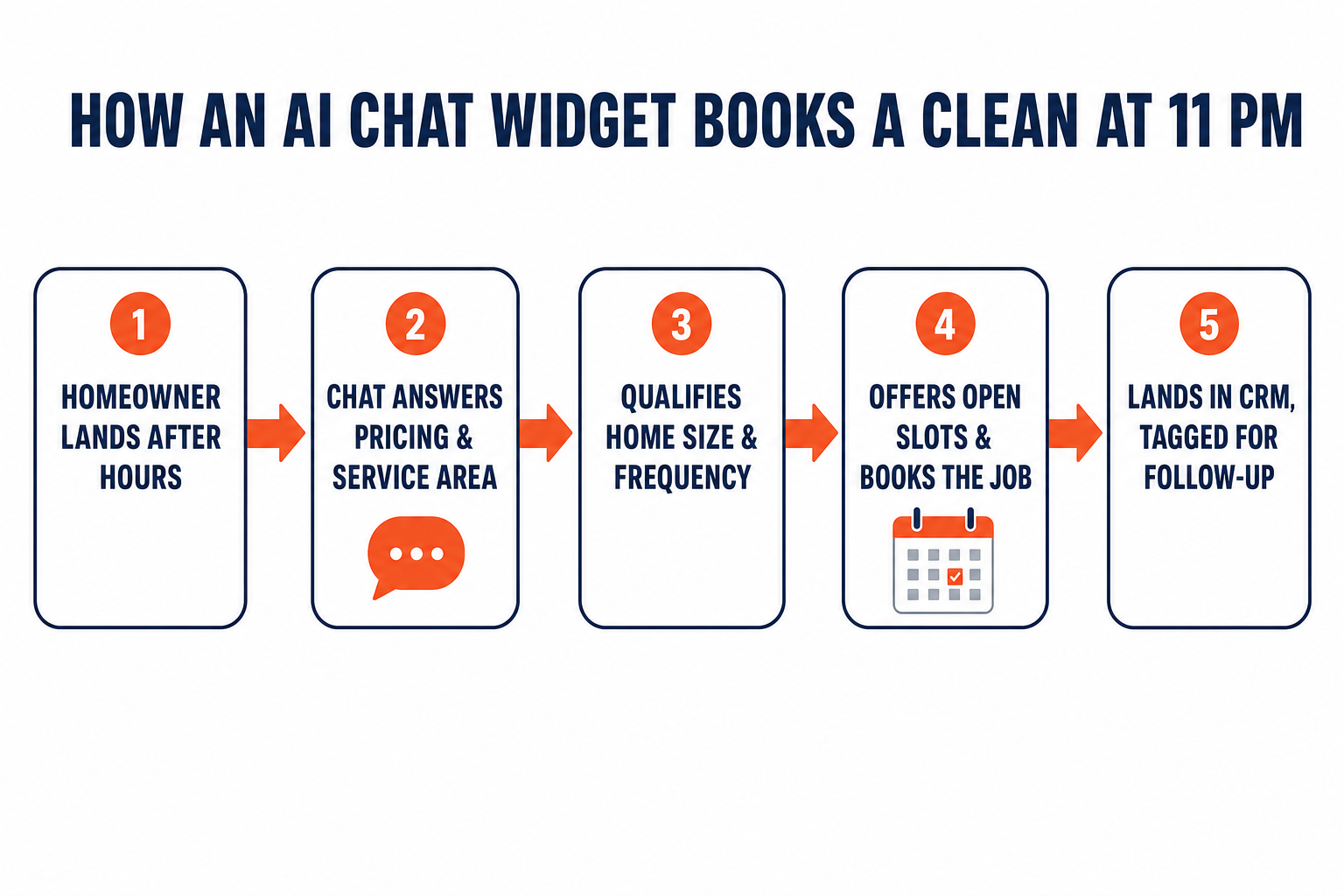
- A homeowner lands after hours. They found you through search, your GBP, or an ad, and it’s 11 PM. The chat widget greets them proactively instead of waiting for a form.
- It answers the real questions. Pricing ranges, what’s included, whether you service Huntersville or Matthews, eco-friendly products, recurring discounts — answered instantly, in your tone.
- It qualifies. It collects home size, frequency, and location, so the lead that reaches you is already scoped instead of a bare name and number.
- It books. It offers your open slots and drops the job straight into appointment automation — a confirmed booking, not a “we’ll call you back.”
- It hands off clean. The contact lands in your CRM tagged and ready, and if the visitor wasn’t ready to book, SMS follow-up picks up the thread the next morning.
The difference between that and a contact form is the difference between a booked Tuesday and a bounced visitor.
An after-hours cleaning lead
9:40 PM: homeowner submits a contact form, hears nothing, books a competitor by 9:55 PM. You see the form at 8 AM — too late.
9:40 PM: AI chat answers pricing + service area, qualifies the home, and books a bi-weekly for Thursday. You wake up to a confirmed job on the calendar.
The cleaning clients who add a real AI chat widget stop asking “how do I get more traffic?” within a month. They already had the traffic — they were just losing it every night at the exact moment someone was ready to book. Plugging that one leak is usually the cheapest jobs they’ll ever add.
The Charlotte math: turning after-hours traffic into recurring cleans
Why does this matter more in Charlotte than in a stagnant market? Volume and timing. Charlotte is now among the national leaders for population growth — the metro pushed past 2.8 million residents in 2025 (U.S. Census via QCity Metro), and North Carolina ranked near the top of the country for new housing-unit growth. The city itself holds roughly 904,000 people at a 51% homeownership rate (Data USA / U.S. Census, 2024).
Every one of those new homeowners is a first-clean waiting to happen — a move-in deep clean, then, if you handle them well, a recurring bi-weekly. And new arrivals shop online, at night, because they don’t have a cleaner they already trust and no neighbor has referred one yet. That’s the highest-intent, worst-covered segment in your entire market, and an AI chat widget is built precisely for it.
The compounding piece is recurring revenue. A booked first clean isn’t a $180 job; it’s the front door to an eighteen-month bi-weekly relationship worth thousands. Miss the 11 PM chat and you don’t just lose one clean — you lose the whole recurring-revenue tail that would have followed. In a market adding this many households, the operator who answers first and books instantly quietly accumulates the recurring book everyone else is fighting over during business hours.
What to look for in an AI chat widget for a cleaning business
Not every chat widget is built for a service business that books jobs. If you’re evaluating one — or the done-for-you snapshot that includes it — hold it to these standards:
- It books, not just chats. Answering questions is table stakes; the point is a confirmed appointment on the calendar, wired into your booking and reminders.
- It knows your service area and pricing rules. It should confidently answer “do you clean my part of Charlotte?” and give real price ranges by home size and frequency — not dodge to “someone will contact you.”
- It qualifies before it hands off. Home size, frequency, service type, and location captured up front, so a human never starts from zero.
- It works on your site and your social channels. The same brain answering website chat, Instagram DMs, and Facebook Messenger, so no channel leaks.
- It’s TCPA-aware. Any follow-up texting it triggers should collect proper consent and honor STOP — see our TCPA guide for cleaners.
- It captures the ones who don’t book. Even a visitor who bails should leave contact details so SMS follow-up can recover them.
How to stop losing after-hours leads this week
You don’t need a bigger team or longer hours to plug this leak — you need something on your website that answers the instant a Charlotte homeowner asks. The AI chat widget does exactly that, and it ships inside the same snapshot as the AI caller, online booking, and CRM, so every channel a lead can arrive through is covered by one system.
If you’d rather see it before you commit, book a quick walkthrough and we’ll open a real GHL account and show the widget answering and booking a clean live — then point it at your own site. Either way, the goal is the same: never lose another 11 PM booking to the cleaner who simply answered first.
Frequently asked questions
What is an AI chat widget for a cleaning business?
It's a branded chat window on your website (and optionally your Facebook and Instagram) that holds a real conversation with a homeowner. It answers pricing, service-area, and availability questions in your voice, qualifies the visitor by home size and frequency, and books the cleaning — 24/7, with no staff online. It matters because 77% of customers now expect an immediate response when they contact a business (Salesforce) and 74% expect service to be available around the clock (Zendesk).
How is an AI chat widget different from an AI phone receptionist?
The chat widget answers people typing on your website or social channels; an AI phone receptionist answers the phone when a call is missed. They solve the same problem — after-hours leads that get no response — on two different channels, and most Charlotte cleaning companies benefit from running both, because some homeowners call and some would rather never talk on the phone. See the AI receptionist playbook for the phone side.
Do after-hours leads really cost that much?
Yes. Contacting a web lead within 5 minutes instead of 30 makes you 21 times more likely to qualify it (MIT/InsideSales), yet the average business takes 42 hours to respond and 23% never respond at all (Harvard Business Review). And home-service calls go unanswered 41% of the time on weekends versus 18% on weekdays (CallRail) — right when homeowners shop. A slow lead is, statistically, a lost lead.
Will an AI chat widget annoy my customers or feel robotic?
A good one doesn't, because it answers natural questions instead of forcing a menu of buttons, and it hands off to a person the moment the conversation needs one. The alternative — a contact form nobody answers until tomorrow — is what actually frustrates homeowners, since most define an acceptable response time as ten minutes or less (HubSpot via Help Scout).
Is texting from the chat widget TCPA-compliant?
It can and must be. Any SMS follow-up the widget triggers should capture clear consent and honor opt-outs like STOP. The snapshot's flows are built with that in mind — read our TCPA compliance guide for cleaning businesses for the specifics. State and municipal licensing, insurance, and bonding remain the operator's responsibility.
How fast can I get an AI chat widget live on my Charlotte cleaning site?
The AI chat widget ships inside the done-for-you snapshot alongside the AI caller, online booking, and CRM, and installs in about 24 hours once we have access to your GoHighLevel sub-account. If you'd like to see it working first, book a walkthrough and we'll demo it booking a clean live.
Darnell Pierce runs a small GoHighLevel agency serving home-service operators, with cleaning companies making up most of his book. He writes about the parts of the business that quietly leak money — slow lead response, after-hours gaps, and half-built funnels — and how to close them with automation that actually books jobs. Statistics cited here are from the linked third-party sources; Charlotte figures are from the U.S. Census Bureau and Data USA.
Related reading: Missed-call text-back for cleaning businesses · The AI receptionist playbook · Online booking for cleaning companies · Instant quote vs. callback · Local SEO for cleaning businesses