
A cleaning service contract is the short written agreement that spells out exactly what you clean, how often, for how much, who pays when, and what happens when something goes wrong. For a residential maid service it fits on one page. For a janitorial account it runs longer because the building, the insurance, and the payment terms are bigger. Either way the job is the same: turn every fuzzy, memory-based “I thought you were doing the baseboards” argument into a line you can point to. Get it right once, reuse it on every client, and you stop losing money to scope creep, lock-outs, and slow payers.
Here is why it matters more than it feels like it should. US residential cleaning is roughly a 357,000-business, $18.8 billion industry, and janitorial services is a separate $112.4 billion market (IBISWorld, 2026). In a field that crowded, the operators who grow are the ones who look professional and do not bleed cash on disputes. A clear contract does both.
This guide walks the whole document top to bottom: what each clause is for, how it breaks when you leave it out, then a full copy-paste residential template plus the janitorial additions. One note first: this is operator-to-operator guidance, not legal advice, so have a local attorney glance at your final version before you use it at scale.
Key Takeaways
- A contract is a boundary, not a threat. It makes scope, money, and consequences unambiguous so you never argue from memory. Clients who book a real service expect to see one.
- Scope of work saves the most money. List what is included, what costs extra, and what you never touch. Scope creep is the quiet margin killer, and a written scope is the only thing that stops it.
- Payment terms do the second-most work. A card on file for residential, clear Net terms and a late fee for commercial, plus a lock-out rule, keep cash flowing without you playing collections.
- Residential and janitorial are not the same document. Janitorial adds insurance limits (commonly $1M per occurrence), a bond, additional-insured language, and a longer term.
- The template below is yours to copy. For the enforcement side (reminders, card-on-file, e-sign), it is pre-built in the Cleaning Snapshot.
Table of contents
- What a cleaning service contract actually is
- What a weak contract costs you right now
- The 10 clauses every cleaning contract needs
- Residential vs janitorial: how the contract changes
- Three real scenarios, three different contracts
- The copy-paste residential contract template
- Common objections to using a contract
- How to send and sign it without friction
- Frequently asked questions
What a cleaning service contract actually is
A cleaning service contract is a written agreement between your company and a client that defines the work, the price, the schedule, and the rules. Call it a service agreement, a cleaning contract, a scope-of-work, or “the paperwork.” What matters is that both sides agreed to the same thing in writing before the first clean.
It is different from a quote (a number) and an invoice (a bill). The contract is the rulebook underneath both, and the only one of the three that protects you when a client says the work was not done, refuses to pay, or wants three extra rooms for the same price. For a recurring residential client, the contract and the booking happen together. For a janitorial account it is a separate signed document after a walkthrough and a bid, because the stakes, insurance, and term length are larger.
What a weak contract costs you right now
Going without a real contract does not make you easygoing. It just moves the cost from the client to you, one job at a time. Three leaks show up again and again.
The first is scope creep. Without a written list of what is included, every visit becomes a negotiation. “Can you also do the fridge?” “The garage just needs a quick sweep.” Each is small; across a biweekly client for a year, they are hours of unpaid labor. With standard visits priced around $120 to $280 and deep cleans 50 to 100 percent higher (Housecall Pro, 2026), giving away a half-hour here and there erases the account’s margin.
The second is non-payment and slow payment. Residential clients without a card on file pay when they feel like it, and commercial clients without written Net terms stretch you to 60 or 90 days while you still make payroll every two weeks. Your cleaners earn a median around $17 an hour (BLS OEWS, May 2025); that wage does not wait for a client’s accounts-payable cycle.
The third is liability and lock-outs. A crew arrives to a locked door, a broken vase, or a client who claims an item went missing. Without clauses on access, damage, and bonding, each becomes an argument you lose or eat. A commercial client often requires $1 million per occurrence in general liability before they even let you bid (Insureon), and a contract that does not match your coverage can lose the account over a paperwork gap.
General liability limits commonly required of cleaning contractors, per occurrence. Standard commercial accounts cluster at $1M; large buildings, hospitals, and school districts often ask for $2M or more. Source: Insureon and MoneyGeek.
The 10 clauses every cleaning contract needs
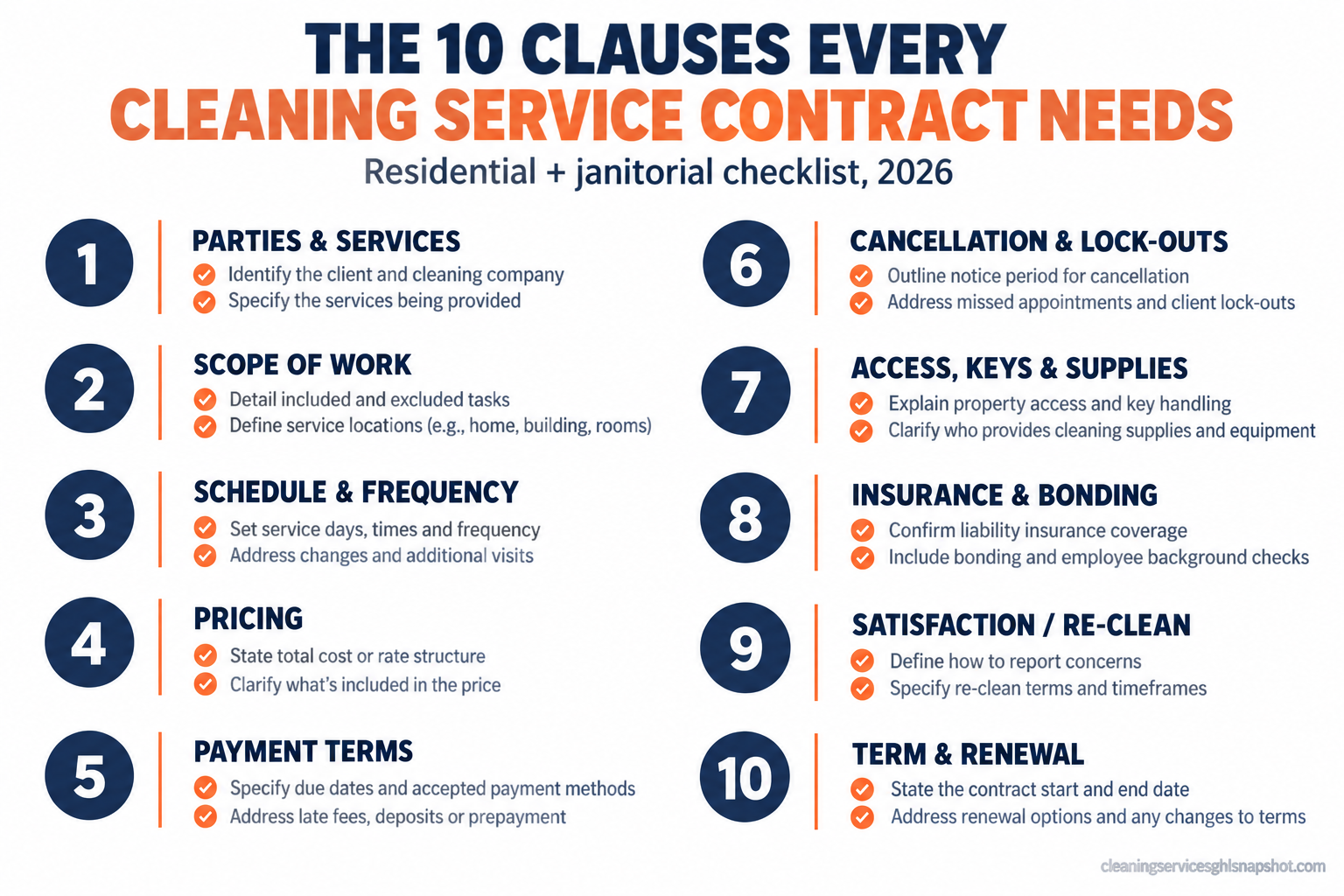
Ten clauses, each closing a specific hole. The exact wording lives in the copy-paste template below; here is what each clause is for and how it fails when you skip it.
1. Parties and services. Your exact legal business name, the client and service address, and a one-line service summary. Skip it and you sign as “Mike’s Cleaning” while your insurance is under an LLC, and a name mismatch can sink you in small claims.
2. Scope of work. The heart of the document: a specific list of what is included each visit, what is a paid add-on, and what you never do. This is the clause that kills scope creep. Without it, every “while you’re here” request becomes free work and every skipped item becomes a complaint.
3. Schedule and frequency. One-time or recurring, how often, which day or window, and how you handle holidays. Skip it and recurring clients treat “biweekly” as “whenever I call.” A written cadence protects your route density, which is where recurring profit lives. See how to build recurring revenue.
4. Pricing and what it covers. The price per visit (or per month), what it includes, and how prices can change. The annual-review line lets you reprice without a confrontation when costs climb. Without it you get locked into a two-year-old rate.
5. Payment terms. When payment is due, how it is collected, and what happens when it is late. It differs most between residential (card on file, charged per visit) and commercial (monthly invoice, Net 15 or 30, late fee). Skip it and residential clients drift into “I’ll pay next time” while commercial clients make you their interest-free lender. See how to get clients to pay automatically.
6. Cancellation, rescheduling, and lock-outs. The notice window, the late-cancel fee, and a locked door treated as a cancellation so you are paid for the drive. Without it, the two most expensive events in your week become pure loss. It deserves its own detail, in the full cancellation policy template.
7. Access, keys, and supplies. How the crew gets in, who provides products and equipment, and how keys or codes are secured. Skip it and a key handoff with no written chain-of-custody is a nightmare if anything goes missing.
8. Liability, insurance, damage, and bonding. Your coverage, how damage claims are handled, and for commercial work, the insurance limits and the bond. A janitorial bond is a surety bond that pays the client if an employee steals, separate from liability insurance (MoneyGeek). A 48-hour damage-notice window stops a client blaming you in month three for a crack that was there in month one.
9. Satisfaction guarantee and re-clean. Replaces refunds with a re-clean: if the client is unhappy, you come back and fix the spot. A vague “satisfaction guaranteed” invites chargebacks for a missed corner; a written re-clean clause keeps you in control of how you make it right.
10. Term, auto-renewal, and termination. How long it runs, whether it renews, and how either side ends it. Handle auto-renewal carefully: New York’s service-contract law can make one unenforceable unless you give written notice 15 to 30 days before the cancellation deadline (Romano Law). If you lock clients into a year, check your state’s rules.
Residential vs janitorial: how the contract changes
The ten clauses are the same skeleton for both, but the weight shifts hard between a weekly maid service and a nightly office account. Residential is short, card-on-file, and month-to-month. Janitorial is longer, invoice-based, insurance-heavy, and term-bound.
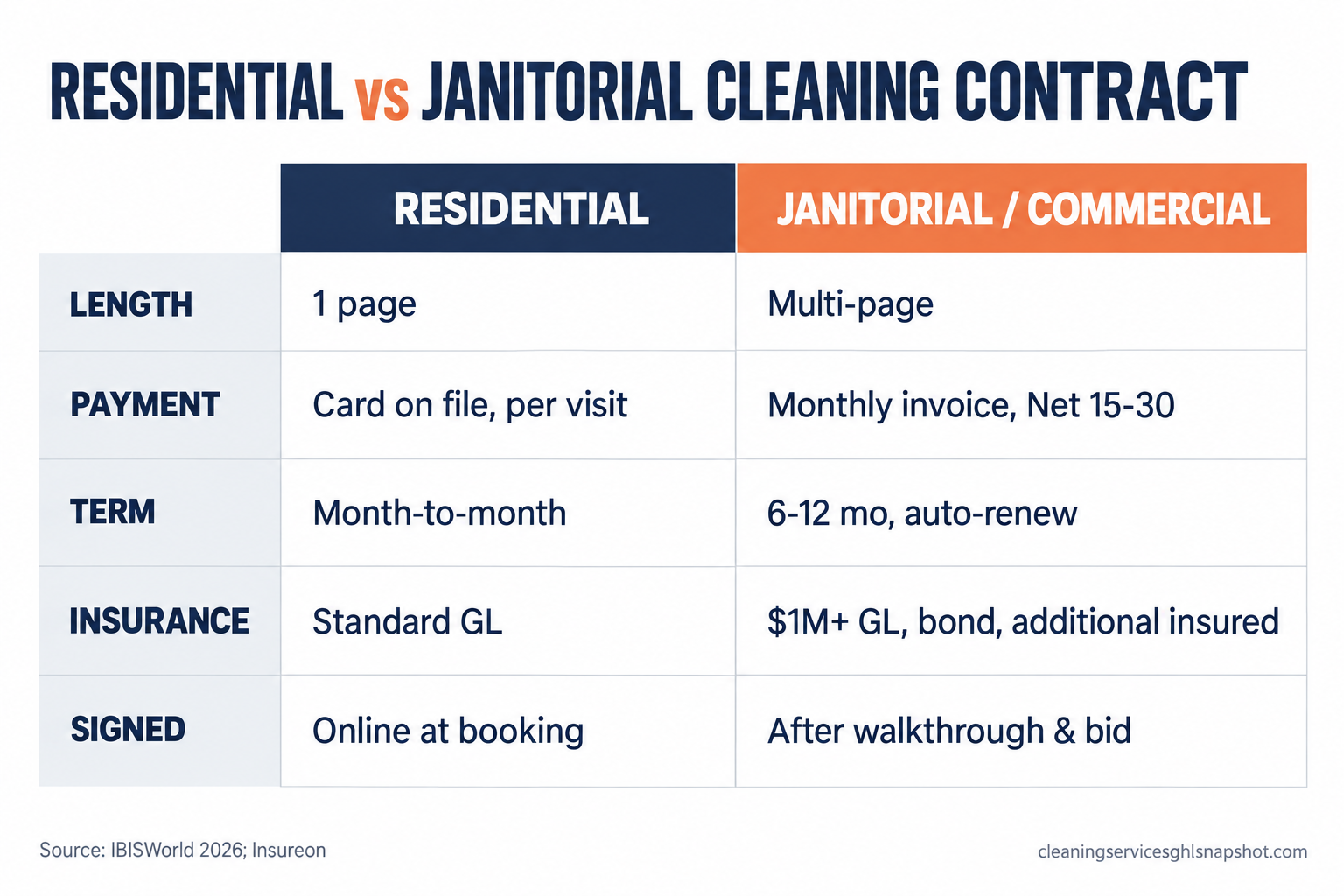
Residential vs janitorial contract: what changes
| Plan | Residential service agreement | Janitorial / commercial contract recommended |
|---|---|---|
| Price | 1 page | Multi-page |
| Feature 1 | Card on file, charged per visit | Monthly invoicing, Net 15 to 30 terms |
| Feature 2 | Month-to-month, 14-day cancel | 6 to 12 month term with auto-renewal clause |
| Feature 3 | Standard general liability is enough | $1M+ GL, additional insured, janitorial bond |
| Feature 4 | Scope in plain rooms-and-tasks language | Scope as a detailed cleaning specification |
| Feature 5 | Signed online at booking in one step | Signed after a walkthrough and formal bid |
| See online booking setup | Win more B2B accounts |
The reason janitorial contracts carry so much more is the money and the risk. A single office or medical account can be worth more per month than a dozen homes, and the owner is handing you keys to a property worth millions. That is why commercial clients require named insurance limits, want to be a named additional insured on your policy, and often ask for a waiver of subrogation (MoneyGeek). Your contract has to match the certificate of insurance you hand them, or the deal stalls. The two markets are different animals, which the raw size of each makes clear.
US market size by segment, in billions of dollars. Janitorial and commercial cleaning is roughly six times the size of residential, which is why its contracts carry heavier insurance, payment, and term clauses. Source: IBISWorld, 2026.
Three real scenarios, three different contracts
The same framework produces a different document depending on who you are serving.
The solo operator booking a one-time deep clean. You do not need a multi-page agreement for a stranger’s move-out. You need the scope of work, a $25 to $50 deposit to filter flakes, a clear price, the lock-out rule, and the damage clause, signed on a phone. The risk is a no-show or a “it wasn’t clean enough” dispute, so the scope list and the re-clean clause carry the weight. Move-out jobs commonly run $250 to $600 (Housecall Pro), real money to lose to a vague scope.
The recurring residential maid service. Your bread and butter, and the contract should be nearly invisible: the client agrees to terms, hands over a card, and picks biweekly, all at booking. Emphasis shifts to the schedule clause, the card-on-file payment clause, and the annual price-review line. The contract does its biggest work months later, when the client wants to add a room or disputes a charge and you point to the signed scope.
The janitorial account bidding on a 20,000 sq ft office. Now the contract is a formal document that follows a walkthrough: a detailed cleaning specification (nightly, weekly, monthly task lists by area), named insurance limits, the bond, Net 15 or 30 terms with a late fee, a 12-month term with a careful auto-renewal clause, and a termination-for-cause section. The insurance and payment clauses are no longer boilerplate. They are the deal.
The first time a property manager asked for my COI naming them as additional insured, I had no idea what he meant and I lost the bid. Now my janitorial contract and my insurance certificate line up before I ever walk in. I have closed three office accounts since, because the paperwork made me look like the serious option.
The copy-paste residential contract template
Here is a complete short-form residential agreement you can adapt today. Swap in your business name, prices, and schedule. Keep it this tight, because a contract nobody reads is a contract nobody follows.
For a janitorial account, keep every clause above and add four: named insurance limits ($1M per occurrence general liability with the client as additional insured), the bond amount, Net 15 or 30 invoicing with a 1.5% monthly late fee, and a fixed term with a termination-for-cause clause. Replace the plain-English scope with a task-by-task cleaning specification organized by area and frequency.
Common objections to using a contract
“Won’t a contract scare off residential customers?” The opposite, in practice. A short, fair agreement signals you are a real business, not a person with a bucket who might vanish. The clients it scares off are the ones planning to haggle, cancel last minute, or dispute a charge, exactly the ones you want to filter out. Frame it as “here’s what you can count on from us” and it reads as professional, not adversarial.
“I’ve done handshake deals for years and it’s been fine.” Fine until it isn’t. The handshake works right up until the one client who claims you broke a lamp, skipped the bathrooms, or never agreed to that price. A contract costs five minutes per client to set up once and reuse, and one avoided dispute pays for the habit a hundred times over. You are not replacing trust, you are backing it up.
“Do I really need a lawyer?” For a standard residential template, adapt a solid starting point like the one above and have an attorney review it once, cheaply. For large commercial or government janitorial contracts, where insurance limits, indemnification, and auto-renewal law come into play, pay for a real review. A lawyer’s hour is trivial next to a six-figure account gone wrong. For existing clients with no paperwork, roll it out as a light touch: “we’re formalizing our service agreement, nothing is changing about your service or price.” Pair it with your client onboarding system so everyone hits the same clean process.
How to send and sign it without friction
A contract that lives in a Word file on your laptop never gets signed, and an unsigned contract protects nobody. Make agreeing to terms a frictionless part of booking. For residential, fold the agreement into the booking step: the client picks a day, sees the scope and policy, ticks a consent box, and enters a card, all in one flow, so terms are agreed and the card captured before the first clean (exactly when consent is fair and enforceable). For commercial, use an e-signature tool so a property manager can sign from their phone the same afternoon as the walkthrough, while the bid is still warm. After signing, the reminders, card-on-file charges, and renewal notices all have to fire on their own, which is the fiddly part to build and the easy part to half-finish.
Booking a client: handshake vs signed agreement
Verbal scope nobody wrote down · price agreed by text and forgotten · no card on file, chase payment every time · scope creep each visit · a locked door is pure loss · a damage claim becomes an argument
Signed scope of work at booking · price and add-ons in writing · card on file, charged automatically · add-ons quoted before you do them · lock-out charged per policy · damage handled by a written 48-hour clause
Frequently asked questions
What should a cleaning service contract include?
Ten core clauses: the parties and services, a detailed scope of work, the schedule and frequency, pricing and how it can change, payment terms, a cancellation and lock-out policy, access and supplies, liability and insurance (plus a bond for commercial), a satisfaction and re-clean guarantee, and the term with renewal and termination rules. Residential contracts fit all of this on one page; janitorial contracts expand the insurance, payment, and term clauses considerably.
Do residential cleaning clients really need a signed contract?
Yes, and it protects you more than it constrains them. A short, fair service agreement defines the scope, locks in the price, puts a card on file, and sets the cancellation rule, heading off the three biggest residential losses: scope creep, non-payment, and last-minute cancellations. Most clients read it as a sign you run a professional operation.
What insurance do I need in a commercial janitorial contract?
Most commercial clients require general liability insurance, commonly $1 million per occurrence, with larger buildings asking for $2 million or more. Many also want to be named as an additional insured and may require a waiver of subrogation and workers' compensation. A janitorial bond is separate: it is a surety bond that pays the client if an employee steals property (MoneyGeek).
Can I use an auto-renewal clause in my cleaning contract?
You can, but check your state's law for term contracts. New York's service-contract rules, for instance, can make an auto-renewal unenforceable unless you give written notice 15 to 30 days before the cancellation deadline (Romano Law). Month-to-month residential agreements are simpler; locked-in annual commercial terms are where this matters most.
How do I get clients to sign the contract without friction?
Fold it into booking. For residential, let the client agree to the scope and policy, tick a consent box, and enter a card in the same step they pick a day, so terms are agreed before the first clean. For commercial, use an e-signature tool so a property manager can sign from their phone right after the walkthrough. A contract that is hard to sign never gets signed.
The bottom line
A cleaning service contract is not a wall between you and the customer. It is the quiet infrastructure that lets you run a real operation without arguing from memory every time a job goes sideways. The scope stops the creep, the payment terms keep cash flowing, and the insurance, access, and termination clauses keep a single bad day from becoming a lawsuit or a lost account. Ten clauses, one page for residential, a few more for janitorial, and you are covered on the three leaks that drain most cleaning businesses.
Copy the template above, make it yours, and have a lawyer glance at the final version. Then make it easy to sign and automatic to enforce, because a signed agreement that still needs you to chase every payment by hand is only half a system. Get the Cleaning Snapshot for $997 with the booking, consent, e-sign, and payment flows pre-built, or book a live walkthrough and watch a new client go from quote to signed agreement to card-on-file in one step.
About the author
Darnell Pierce is a GHL Automation Consultant in Atlanta, GA. He runs a small GoHighLevel agency serving home-service operators, with cleaning companies making up the bulk of his book. He’s allergic to half-built funnels and TCPA shortcuts, and he’d rather ship one bulletproof quote-to-book flow than ten clever-but-fragile ones. He covers the agency side of the business: what to white-label, what to charge, and how to onboard a cleaning client in a week without breaking their existing calendar.
Related posts
- Cleaning Business Cancellation Policy: The Template, Fees, and Automations That Stop No-Shows
- How to Get Commercial Cleaning Contracts: A 2026 Playbook to Win B2B Accounts on Autopilot
- 1099 vs W-2 for Cleaning Businesses: What It Really Costs to Get It Wrong in 2026
- Cleaning Business Client Onboarding: The System From Booked to a First Clean They Rebook
Sources
- IBISWorld: Residential Cleaning Services in the US (2026)
- IBISWorld: Janitorial Services in the US (2026)
- Housecall Pro: House Cleaning Prices (2026)
- US Bureau of Labor Statistics: Maids and Housekeeping Cleaners, OEWS May 2025
- Insureon: Janitorial Services Insurance
- MoneyGeek: Janitorial Insurance Requirements
- Romano Law: Automatic Renewal Provisions May Not Be So Automatic