It is Thursday afternoon and a woman named Dana books her first clean through your website: a three-bed, two-bath deep clean before her in-laws visit. You see it, feel good, and move on. Nobody sends her anything. On Monday your crew pulls up to no lockbox code, a dog loose in the yard, and Dana at work assuming the team knows the guest room is the priority. The crew calls you. You call Dana. Twenty minutes of the slot burns before anyone picks up a mop. The clean gets done, but the guest bath got rushed and the in-laws’ room got the leftover time. Dana pays, says “thanks,” and never books again.
You did not lose Dana on the quality of the clean. You lost her in the silence between “booked” and “the crew walked in.” A first clean is the highest-stakes job you will ever do for a customer, because it decides whether they are worth $150 or $4,000 to you, and most owners leave those 72 hours to chance. This guide is the fix: a six-stage client onboarding system that runs from the second they book to the moment you ask them to rebook, the exact messages you can steal, and how it changes with the size of your shop.
Key Takeaways
- The first clean is a retention event, not a cleaning job. Whether a client becomes recurring is mostly decided before your crew arrives, by how well you set the clean up.
- Retention is where the money is. Per Bain & Company, keeping 5% more customers lifts profit by 25% to 95%. A recurring biweekly home is worth thousands; a one-off is worth one visit.
- A day-before confirmation prevents the worst failures. In a meta-analysis of clinic visits, a digital reminder pushed attendance from 54% to 67% (Robotham et al., BMJ Open 2016), and it stops the locked-door first clean.
- The crew cannot nail a first clean they were never briefed on. Access, pets, parking, and the client’s top three priorities have to reach the team before they knock.
- Build it as a system, not a habit. Onboarding dies the instant a job runs long, so the welcome, intake, confirmation, and rebook ask have to fire on their own.
Table of contents
- Why the first clean decides everything
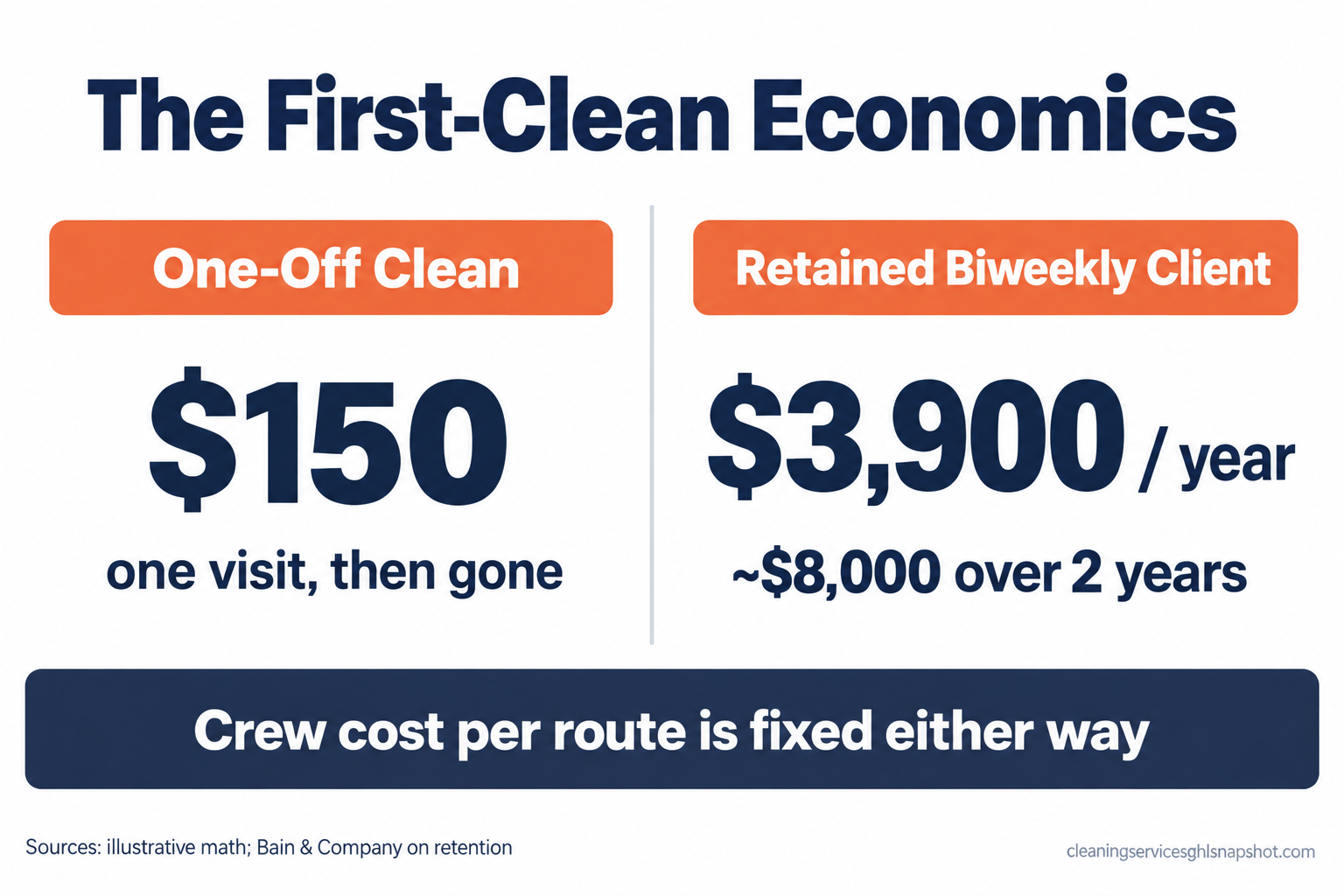
- The 6-stage cleaning client onboarding system
- The exact onboarding messages you can steal
- Does a day-before confirmation really move the needle?
- The same system at three sizes of business
- Onboarding texts and TCPA: staying legal
- The objections I hear from owners
- Frequently asked questions
- The bottom line
Why the first clean decides everything
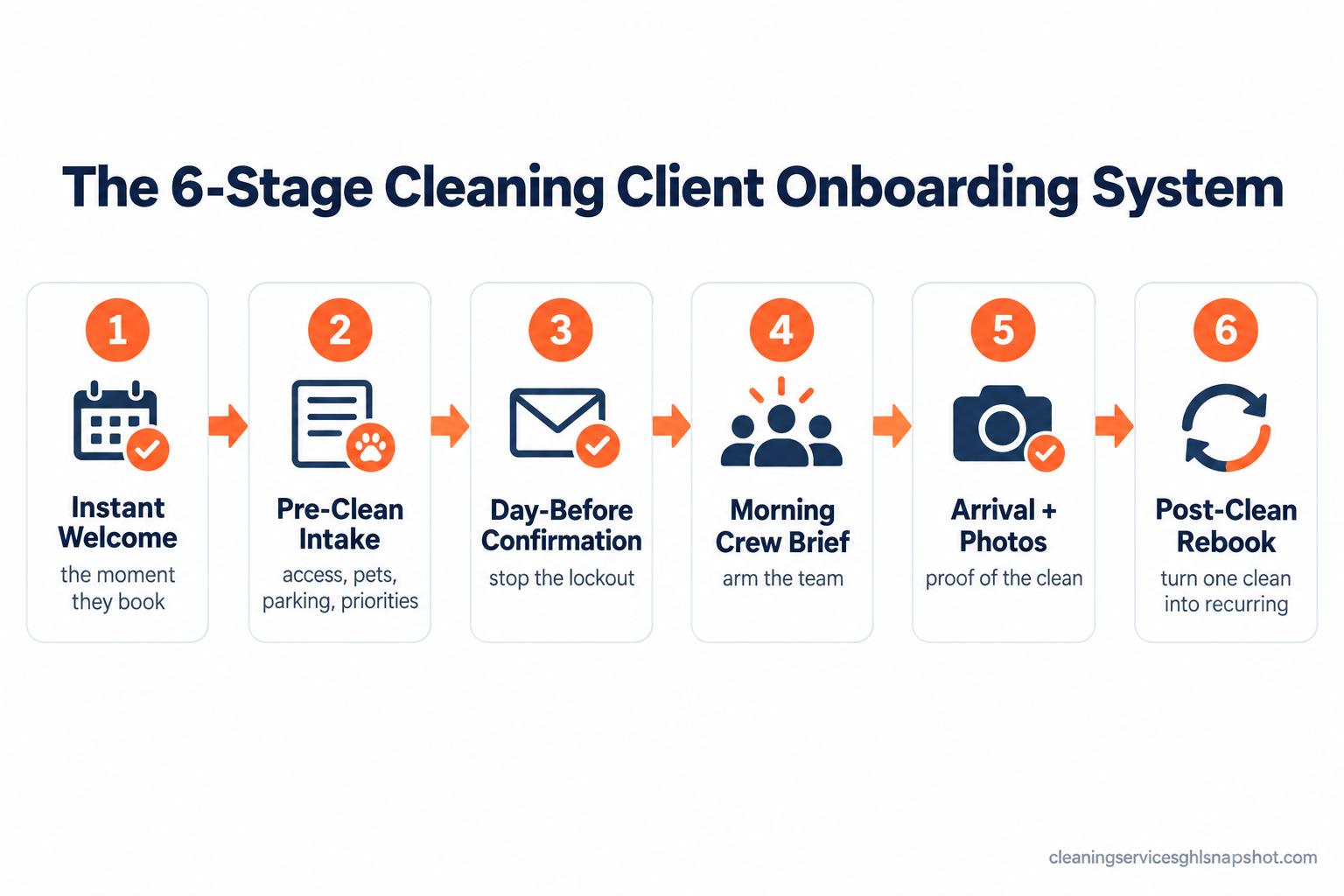
Run the math on Dana. A biweekly three-bed at $150 a visit is 26 cleans a year, about $3,900. Keep her two years and she is worth close to $8,000. When that first clean went sideways you did not lose a $150 job, you lost the customer you already paid an ad or referral fee to win, at the moment she was most willing to commit.
That is the part owners miss. A first-time client is not a skeptic yet. She cleared her Monday and gave a stranger a key, and a smooth first experience is what turns her from a nervous one-time buyer into a standing appointment. Retention is where the profit hides: Bain & Company found that lifting customer retention by just 5% raises profit anywhere from 25% to 95%.
The labor math sharpens it. With about 860,670 maids and housekeeping cleaners employed at a median $17.07 an hour (BLS OEWS, May 2025), your crew cost for a route is fixed whether the stop is a one-off or a lifer, so every first clean you convert to recurring earns far more on labor you already pay for. In a $18.8 billion US residential cleaning market of roughly 357,000 businesses (IBISWorld, 2026), the operators who win are rarely the best scrubbers. They are the ones whose first clean feels handled.
The 6-stage cleaning client onboarding system
Every failed first clean traces to the same root cause: the handoff from “booked” to “cleaned” lives in your head instead of in a system, so it falls apart the second you get busy. Build it once and it runs on every new client, including the ones who book while you are elbow-deep in a move-out.
| Stage | Timing | Channel | Goal |
|---|---|---|---|
| 1. Instant welcome | The moment they book | Text + email | Confirm and reassure |
| 2. Pre-clean intake | Within an hour | Form link via text | Capture access and priorities |
| 3. Day-before confirmation | ~24 hours out | Text | Prevent lockouts and no-shows |
| 4. Morning crew brief | Day of, before arrival | Internal job sheet | Arm the crew |
| 5. Arrival + during | On the way, and on-site | Text + photos | Signal pro, capture proof |
| 6. Post-clean close | Same day, 2–4 hours after | Text | Get the review and the rebook |
Stage 1, the instant welcome. The second Dana books, a warm message goes out: you are confirmed, here is what happens next, here is how to reach a human. It kills fresh buyer’s remorse and signals you are organized. How it breaks: the welcome is a bare calendar receipt with no warmth, so the client still feels unsure. Fix it with a real, friendly note, not a system-generated “appointment confirmed.”
Stage 2, the pre-clean intake. This is the stage almost nobody runs, and the one that saves the first clean. Right after booking, send a short form for what your crew needs and does not have: how to get in, pets and where they will be, where to park, products to avoid, and the customer’s top three priorities. Your online booking flow should feed this automatically. How it breaks: you ask for everything and it feels like a mortgage application, so nobody finishes it. Keep it to six or seven questions, access and priorities required.
Stage 3, the day-before confirmation. About 24 hours out, a text goes out with the arrival window and a one-tap way to reschedule. It is the highest-return message in the sequence: it catches the “oh no, that is tomorrow” cancels while you can still backfill the slot, and it stops the locked-door clean. It works like the appointment reminders you already send recurring clients. How it breaks: no easy reschedule option, so a client who needs to move it goes silent and no-shows. Give a one-tap out.
Stage 4, the morning crew brief. Before the team knocks, they get the job sheet built from the intake form: access, pets, parking, the top three priorities, and product notes. A crew that walks in knowing the guest bath is the priority delivers a different clean than a crew guessing. How it breaks: the brief lives in your phone and the crew never sees it. Push it to their phone or job app automatically, not verbally at 6am.
Stage 5, arrival and during. An “on our way” text when the crew leaves the prior job, and before-and-after photos captured on-site. The text removes the “are they coming?” anxiety; the photos are proof for the review ask and a paper trail if anything is disputed. How it breaks: the crew forgets the photos, so you have no proof and no review ammo. Make photos a required step to close the job.
Stage 6, the post-clean close. A few hours after the clean, one warm message: thank you, a review link, and the rebook offer. This is the whole point of the system: you turn a first clean into recurring revenue. Ask for the standing appointment while the fresh-house feeling is still in the air, not two weeks later. The mechanics are the same ones that stop clients from ghosting after one visit. How it breaks: you wait too long, or the review and rebook land as two demands. Send it same-day, lead with the thank-you, make the rebook a single easy yes.
The exact onboarding messages you can steal
Steal these, swap in your details, and keep them short.
The form itself should ask, in this order:
The last message thanks first, asks for the review second, and frames the rebook as the normal thing “clients your size” do, with one specific slot and a small incentive. That is the difference between a one-off and a recurring-revenue engine.
Does a day-before confirmation really move the needle?
Yes, and it is the cheapest insurance in the system. The evidence comes from clinics, but the mechanism matches a cleaning schedule: without a nudge, a booked slot dies empty or behind a locked door. In a meta-analysis of clinic attendance, patients who got a digital reminder showed up 67% of the time versus 54% with no reminder (Robotham et al., BMJ Open 2016), and a separate review found SMS reminders alone cut missed visits by around 39% (Israel Journal of Health Policy Research, 2023).
Attendance rate with a digital reminder versus none. Source: Robotham et al., “Using digital notifications to improve attendance in clinic,” BMJ Open 2016.
Send that confirmation by text, not email: business texts get opened at rates as high as 98%, versus roughly 20% for email, the same reason missed-call text-back beats a voicemail nobody plays.
The same system at three sizes of business
The six stages are universal. What running them looks like depends entirely on the size of your shop.
The solo operator. You are the whole system, which is your strength and your trap. You can send a warm welcome, but on a packed week stages 1 through 3 evaporate because you forget. Automate the instant welcome and the day-before confirmation so they fire without you, then read the intake form the night before each new client. That trigger, plus a confirmation 24 hours ahead, kills most of your locked-door mornings.
The mid-size residential shop (5 to 15 cleaners). You cannot personally welcome every client, so onboarding has to be trained and tracked, not remembered. Decide who owns it (an office manager, a virtual assistant, or an automation), put all six stages on autopilot, and watch one number: first-clean-to-recurring conversion. Of the new clients you cleaned this month, what percentage booked a standing appointment? If you cannot answer that, you are blind on the metric that funds your growth. The crew brief matters most here, because the booker is no longer the cleaner.
The commercial and janitorial operation (15 to 50-plus). Onboarding is longer and higher-stakes, because the first clean of a new facility is a live audition for a contract. The stages hold but stretch: the intake becomes a site walkthrough and scope document, the confirmation goes to a facilities manager, and the crew brief includes security, badge access, and after-hours protocols. The post-clean close is a quality check-in with the decision-maker, not a rebook text. The deadliest failure is a flawless bid followed by a sloppy, silent first month, because a facilities manager reads a missed detail as a preview of the whole contract.
Onboarding texts and TCPA: staying legal
Automated welcome, confirmation, and rebook texts are covered by the Telephone Consumer Protection Act, so run them clean. Messages about a clean the customer booked sit on firmer ground, but the rebook offer tips into marketing, so treat the whole sequence like it needs consent. Put a visible line on your booking form that they agree to receive texts and calls about their service, keep a record, honor STOP the instant it lands, and text during reasonable hours.
There is a second trap. If you send from a US 10-digit number, carriers now require A2P 10DLC registration, and unregistered traffic gets silently filtered, which is why plenty of owners switch on texting and watch delivery rates crater. None of this is legal advice, but the short version is: get permission, register your number, honor STOP. Our TCPA guide for cleaners has it.
The objections I hear from owners
“Isn’t this a lot of texts for one clean?” Count them: a welcome, a form link, a confirmation, an on-our-way, and a thank-you. Five useful, spaced messages tied to a service she booked. That is not spam, that is a business with its act together.
“My crews are great. Won’t the work speak for itself?” Only if the work gets a fair shot, and a first clean without onboarding usually does not. Great cleaners still get locked out, guess wrong on priorities, and burn twenty minutes sorting out access. The system clears the runway so the good cleaning lands and gets seen.
“I already use Jobber or Housecall Pro for scheduling.” Those tools are good at putting the visit on a calendar and sending an invoice. They are thin on the onboarding sequence and rebook ask that convert a first clean to recurring, so plenty of owners run this alongside their field software. If you are weighing platforms, our GoHighLevel vs Jobber breakdown covers where each earns its keep.
“Do I need to be technical to set this up?” No. Every stage is a message on a trigger: booking fires the welcome and form, a timer fires the confirmation, closing the job fires the thank-you. You write the copy once and it runs.
Frequently asked questions
What should a cleaning business ask new clients before the first clean?
The essentials your crew cannot guess: how to get in (lockbox, garage code, someone home), whether there are pets and where they will be, where to park, the client's top three priorities, and any products or scents to avoid. Keep the intake form to six or seven questions so people finish it, and make access and priorities required.
How soon should I contact a new cleaning client after they book?
Immediately. Send a warm welcome the moment the booking lands, then the intake form within the hour. The minutes right after someone commits are when buyer's remorse hits and when they are most willing to give you the details you need, so do not wait until the day before.
Does a day-before confirmation text actually reduce no-shows?
Yes. In a meta-analysis of clinic attendance, a digital reminder raised show-up rates from 54% to 67%, and SMS reminders alone cut missed visits by around 39% in a separate review. That same confirmation also catches last-minute reschedules while you can still backfill the slot and prevents the locked-door first clean.
When should I ask a first-time cleaning client to rebook?
The same day, a few hours after the clean, while the fresh-house feeling is strong. Lead with a genuine thank-you, share the photos, ask for a review, then offer one specific recurring slot with a small incentive. Waiting two weeks lets the feeling fade and the rebook rate drops.
Are automated onboarding texts legal for a cleaning business?
Yes, when you follow the rules. Messages about a service the customer booked are on firmer ground, but the rebook offer tips into marketing, so collect clear consent on your booking form, keep a record, honor STOP immediately, and text during reasonable hours. From a US 10-digit number you also need A2P 10DLC registration or carriers filter your texts. This is not legal advice; your compliance is your responsibility.
What is a good first-clean-to-recurring conversion rate?
Measure your own before chasing a benchmark: of the new clients you cleaned this month, what percentage booked a standing appointment? Most shops that run a real onboarding sequence, from welcome to same-day rebook offer, can lift that number within a quarter. Watching it climb matters more than any single target.
The bottom line
Dana was never a lost cause. She was a booked recurring client who slipped away in the quiet 72 hours between the booking and the crew’s arrival, undone by a missing lockbox code and a priority nobody relayed. You did not need better cleaners to keep her. You needed a welcome that reassured her, an intake that armed your crew, a confirmation that aligned everyone, and a rebook ask sent while her house still smelled like a fresh start.
Build the six stages once, make them run on their own, and measure your first-clean-to-recurring rate every month. Do that and you stop competing on who scrubs best, which is hard to prove on visit one, and start competing on who feels easiest and safest to hand a key. Meet the client with a system, and the first clean sells the next hundred. When you are ready to automate it, the appointment automation and SMS automation in the snapshot are where it lives.